8 hours

You must log in or register to comment.
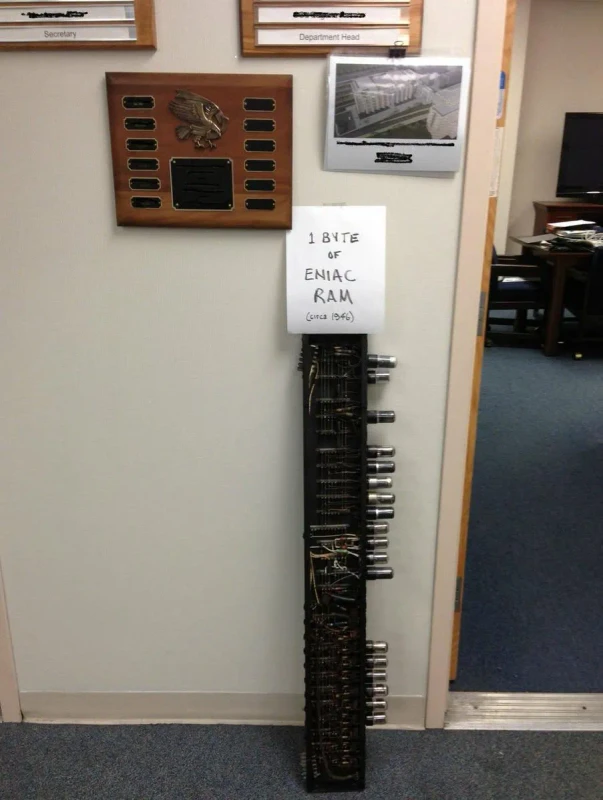
Fake. The only RAM ENIAC ever had was 100-word magnetic core memory since 1953. That means 4×100 ferrite cores, each a few mm, wired in a matrix, likely 10×10 for each of the 4 bits since the computer used a kind of binary-coded-decimal system (Excess-3). The address decoding and R/W logic made of vacuum tubes definitely took up lots of space but the memory itself was likely very small and not worth making modular beyond separating the 4 bitplanes because of all the wires in the matrix and high reliability compared to tubes and electromechanical parts.
To be fair, the picture allegedly shows 8 out of 400 (1/50) of all bits available to the ENIAC, and I wouldn’t be surprised if the memory expansion’s logic took 50x the space of the module pictured.
- 4 hours
I finally figured out who put the bomp in the bomp-shoo-womp-shoo-womp but I’m still at a loss as to who put the ram in the ram-a-lam-a-ding dong. I personally think it’s being artificially inflated.
- 7 hours
And I’m pretty sure it only actually stores 4 bits (https://en.wikipedia.org/wiki/Excess-3), so half a modern byte.
Judging from wikipedia, it was also built as an upgrade for the original computer in 1953 (not 1946).
Wikipedia says the computer had no working memory per se, only storing data on tape, until the 1953 addition of 100-word magnetic core RAM. That means 4×100 ferrite cores, each a few mm, wired in a matrix, likely 10×10 for each of the 4 bits since the computer used a kind of binary-coded-decimal system (Excess-3, as you mentioned). The address decoding and R/W logic made of vacuum tubes definitely took up lots of space but the memory itself was likely very small and not worth making modular because of all the wires in the matrix and high reliability compared to tubes and electromechanical parts, so the label is probably incorrect not just by year.
- 3 hours
ENIAC was one of the (if not the) first electronic, programmable digital computers
Digital mechanical computers exist, and so do analog electronic (electromechanical, vacuum-tube, transistorized or hybrid) ones: digital/analog is a distinction of how they represent numbers. This one is all-digital (binary-coded-decimal in Excess-3 coding) and most of the logic is done in tubes but there’s lots of relays too. The RAM was magnetic-core and likely not actually what’s in this picture.